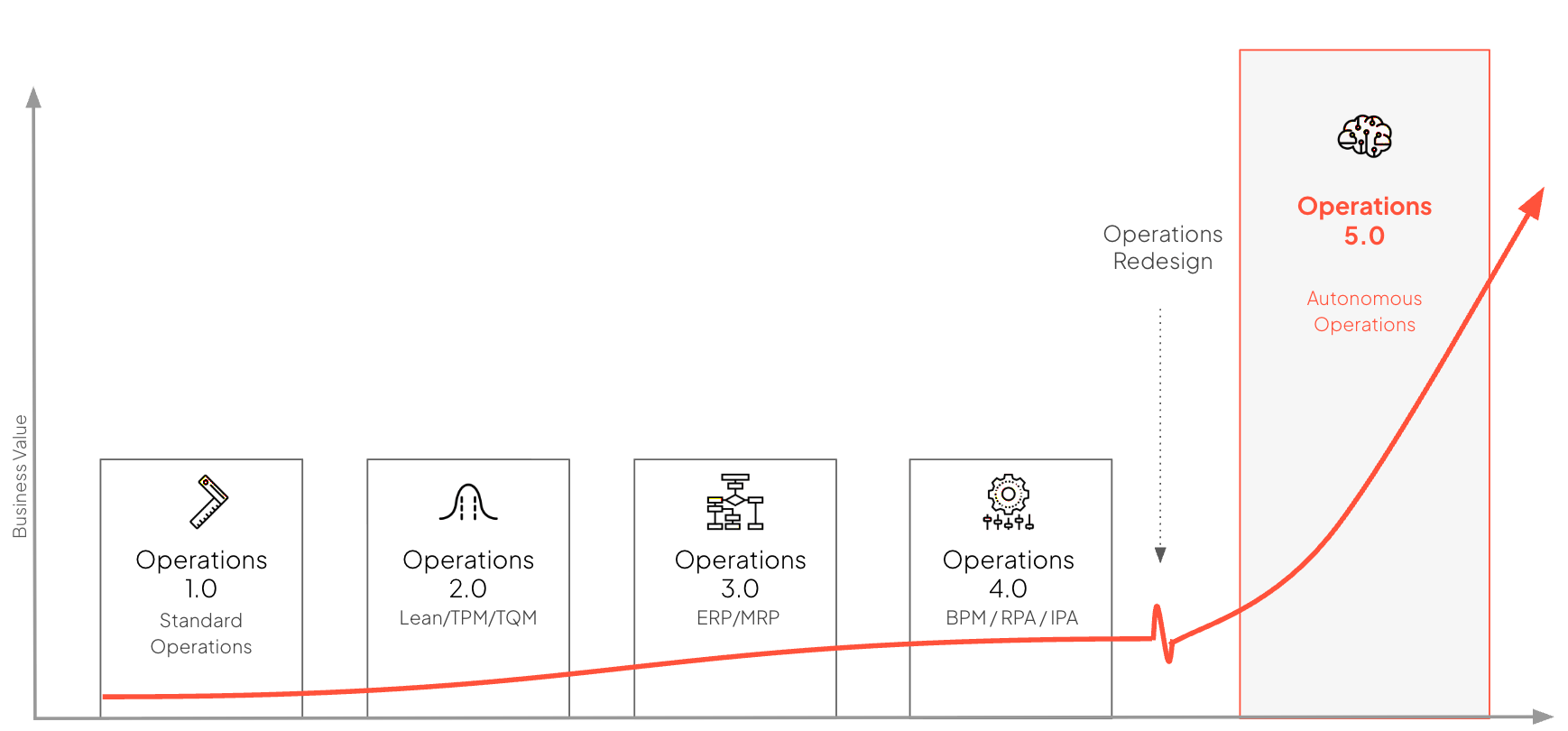
Operations has undergone four major transformations — from work standardization to lean manufacturing to ERP to robotic process automation. Each wave brought new tools and techniques. None changed the underlying architecture. Processes remained sequential, rigid, and human-centric. Automation made them faster. It didn't make them better.
Stockholm, Sweden
Stockholm, Sweden
Amsterdam, Netherlands
of operations capacity consumed by unstructured, reactive, non-productive work
left for strategic execution, decision-making, and the work that actually moves the business
Seven principles that define what operations should be — not what legacy systems have forced them to become.
Operations must achieve multiple business objectives instead of making trade-offs between them.
Automation should improve performance and resilience, not just speed and efficiency.
Procedures are productivity hacks for human cognitive limits. Agents reason across dimensions and use sophisticated tools to deliver outcomes directly.
Traditional systems stop when humans stop. Agentic operations run autonomously 24/7, freeing humans to strategize, analyze, and govern.
Compliance should evolve with operational reality. Force-fitting operations into pre-designed processes only creates risk.
Compress the time between business requirements and operational execution from months to minutes.
Trade-offs exist because of human cognitive and computational limitations. Systems designed for adaptability dissolve them.
Achieve 10X more and 10X faster with existing systems and resource base — at lower cost, higher flexibility, and better compliance.
If Operations 5.0 is the paradigm, Autonomous Operations is how it runs. Agents replace sequential workflows with adaptive, goal-driven execution — turning cost centers into growth engines. Companies that redesign operations for agentic execution deliver 100x returns with less than 10% of traditional investment.
Agents are the primary operators — running operations 24/7 under human oversight. Define outcomes and let agents determine the optimal execution path.
Design, test, and deploy new strategies and business logic in 20 minutes or less. No more waiting months for systems to catch up with business needs.
Operations 5.0 transforms execution units into adaptive engines that translate demand directly into revenue and profitability.
Collapse weekly and monthly planning cycles into continuous adaptation. Deploy new operations in two weeks and reconfigure without losing compliance.
All business logic, policies, and strategies encoded as blueprints. Dynamic missions replace fixed rules — agents execute them instantly.
Humans own macro-decisions on strategy and policy. Agents execute micro-decisions in real time — aligned to organizational structures, roles, and access controls.
Six conversations that define the next era of operations — when agents run execution and leaders redefine their role.
When agents absorb the manual work — scheduling, status chasing, exception handling — operations leaders don't lose their jobs. They get them back. What does the human role become when the work runs itself?
Traditional strategy assumed human constraints — shift limits, skill gaps, decision fatigue. Remove those and the entire strategic calculus changes. Faster cycles. Parallel execution. Decisions at the speed of data.
Start with high-frequency, low-consequence workflows. Deploy agents. Demonstrate results. Expand. A 4–8 week implementation model that gets your first autonomous operation live.
Every operational policy — approval thresholds, escalation rules, compliance protocols — was designed for human judgment. Agents need machine-readable policies that define boundaries and guardrails in real time.
Agents will make mistakes. The question is how to build governance structures that make errors visible, traceable, and correctable before they cascade. Decision audit trails and accountability frameworks.
Autonomous operations don't stop at your firewall. Suppliers, logistics partners, customers — each running their own agents. An ecosystem of autonomous operations that coordinate across organizational boundaries.
Leaders pioneering the shift to agent-driven operations across industries.
Operations leaders who know the shift is real — and are done waiting for someone else to figure it out.
Redefining what the operations function owns in an agent-driven enterprise.
Moving from optimized processes to autonomous planning and execution.
The next frontier beyond lean and six sigma — continuous autonomous improvement.
Designing the operating model that most digital programs promised but never delivered.
The leaders who will run operations in five years need to be in this conversation now.
Frameworks, playbooks, and hands-on programs to start the transformation.
Convert traditional processes into autonomous operations and build agents to run them — in two weeks.
→Lead the Operations 5.0 transformation for your organization with agents at the helm. Hands-on immersion in days.
→Convert your traditional processes into autonomous operations using Kovant Canvas — all in two weeks.
→Operations 5.0 isn't a roadmap for next year. Companies are deploying autonomous operations today. The question is whether you'll define the standard or chase it.